

Governance in Project Delivery
Agentic AI is reshaping the very foundations of governance in project delivery, heralding a bold new era for construction, infrastructure and capital projects. No longer confined to traditional oversight, project controls are being revolutionised by AI’s capacity for dynamic resource allocation, relentless learning and the empowerment of visionary leaders such as the Controls Manager.
These intelligent systems do not simply optimise performance, they actively drive adaptive, data-centric environments where decision-making is agile, transparent and deeply aligned with organisational values. By embracing AI-enabled models and assembling expert governance teams, organisations unlock unparalleled levels of operational efficiency, trust and strategic clarity.
Hierarchical, stage-gate, and collaborative frameworks are being reimagined through the lens of AI, setting aspirational benchmarks for project delivery, stakeholder engagement and long-term resilience.
The future of governance belongs to those who harness the agentic power of AI, where innovation, accountability and excellence are woven into the fabric of every project.
The integration of Artificial Intelligence and the AI Controls Team is reshaping governance practices within project management, particularly by enhancing oversight, transparency and operational efficiency. Through automation, AI can monitor project activities, detect anomalies and provide real-time analytics, all of which empower governance boards to make informed decisions and uphold compliance requirements. The AI Controls Team is responsible for designing robust governance frameworks, embedding AI tools to enable continuous oversight, and maintaining accountability through transparent reporting and proactive issue resolution.
Within the AI Controls Team, specialist roles such as Ethics and Compliance Lead, Data Governance Lead, and Data Scientist / AI Engineer work collaboratively to maintain high standards of data quality, meet regulatory requirements and ensure adherence to ethical principles. By leveraging AI-powered analytics, these specialists validate data, assess project performance and facilitate feedback mechanisms, resulting in a governance process that is resilient, transparent and adaptable to change.
Open communication and active stakeholder engagement are central to the AI Controls Team’s approach, enabling continuous refinement of governance processes. This ensures that governance remains responsive to organisational needs and sets new standards for excellence in project delivery.
Routes of Governance
In the context of construction, infrastructure, and capital projects, governance typically centres on structured frameworks designed to guarantee accountability, transparency and strategic alignment throughout the project lifecycle. The most prevalent models include hierarchical governance, stage-gate governance and collaborative governance.
- Hierarchical Governance: This model is characterised by centralised decision-making authority among senior executives, most commonly applied to high-risk or strategic projects. Its advantages include clear authority, efficient decision-making and scalability for complex projects. However, it can also introduce rigidity, bureaucracy and communication barriers, which may slow down processes and limit collaboration.
- Stage-Gate Governance: Utilising formal checkpoints at key phases of initiation, design, implementation and completion stage-gate governance helps validate progress and control risks. Pros include strong risk mitigation, structured progress control and flexibility to stop or redirect projects. Cons involve potential delays due to frequent reviews and a tendency to prioritise compliance over innovation.
- Collaborative Governance: This model emphasises stakeholder engagement and joint decision-making, which encourages shared accountability and resource pooling. It fosters innovation and builds stakeholder buy-in, though it can be complex and time-intensive, with a higher potential for conflict due to differing priorities.
For large-scale projects, governance frameworks often incorporate risk management, compliance protocols and performance monitoring systems to safeguard cost, schedule and quality objectives. The aim is to balance control with agility, ensuring value delivery while meeting regulatory, financial, and sustainability requirements.
Gateway Governance
The Stage-Gate governance process structures project management into distinct phases called stages these separated by decision checkpoints, or gates. Each stage focuses on specific deliverables (e.g., ideation, scoping, design, execution, validation), while each gate serves as a formal review point to assess progress, risks and alignment with strategic objectives. Gates act as “go/no-go” decision points based on criteria such as feasibility, cost, schedule and compliance. This methodology enhances risk management, quality control, and stakeholder alignment, promoting transparency and accountability.
Governance Application
- High-Risk / Complex Projects: For large-scale, high-uncertainty projects, most gates are maintained but early conceptual stages are combined for efficiency. A combined Discovery and Scoping gate is used, followed by separate gates for Business Case, Development and Validation, and a final Launch gate for readiness and stakeholder approval. This approach preserves control and rigorous risk mitigation while avoiding unnecessary duplication.
- Medium-Risk / Moderately Complex Projects: For projects of moderate complexity, gates are amalgamated to strike a balance between governance rigour and efficiency. Discovery, Scoping, and Business Case are reviewed in a single gate, followed by a combined Development and Testing gate, and a final Launch gate.
- Low-Risk / Simple Projects: Small-scale projects have a single, integrated gate before implementation, with an optional post-launch review for lessons learned. This minimises overhead while maintaining accountability and resource control.
The underlying principle is that higher risk and complexity require more granular gate reviews, whereas streamlined gates accelerate delivery for lower-risk projects without sacrificing essential oversight.
AI in Governance
AI has the potential to transform the Stage-Gate governance process by automating oversight and enhancing decision-making at every phase. AI tools can validate documents against gateway criteria, flag inconsistencies and ensure completeness using natural language processing. Integration with platforms like SharePoint allows AI to track file progress, assess approval status and send reminders for pending actions.
For Gateway meetings, AI can compile agendas, generate document packs and synthesise project data into dashboards, improving stakeholder alignment and reducing manual effort. After meetings, AI-driven transcription and summarisation capture decisions and action items, updating governance records and communicating outcomes efficiently. This intelligent automation accelerates processes while improving transparency, consistency, and compliance.
In List
AI-driven controls enhance governance by enabling dynamic management of annual budget allocations through intelligent prioritisation and phased project releases. By continuously analysing performance data, risk profiles and strategic objectives, AI can recommend which projects should proceed immediately and which should remain on an “In List” for future activation. This approach ensures that capital is deployed where it delivers the greatest value, while maintaining flexibility to adapt to changing conditions. Through predictive analytics and scenario modelling, AI supports Finance and Governance teams in maximising CAPEX efficiency, reducing idle funds and aligning portfolio decisions with organisational goals.
As AI continues to evolve, its role in governance frameworks is expanding beyond traditional process automation to encompass advanced analytics, scenario planning and proactive risk identification. By leveraging machine learning and predictive modelling, AI can anticipate emerging issues, optimise resource deployment and support real-time decision-making throughout the project lifecycle. This proactive approach not only streamlines gateway reviews and enhances oversight, but also enables governance bodies to respond more swiftly to risks and opportunities. As a result, organisations can better safeguard project outcomes, accelerate approvals and maintain robust compliance, all while fostering a culture of continuous improvement and innovation in project delivery.
Project Definition Rating Index (PDRI)
The Project Definition Rating Index (PDRI) is a structured methodology used to measure the completeness of scope definition during front-end planning. By scoring elements across Basis of Project Decision, Basis of Design and Execution Approach, governance bodies can objectively assess project maturity at decision points such as stage gates. This reduces subjectivity, ensures information quality and highlights gaps for action. Iterative application of PDRI at multiple gates supports informed decision-making, accelerates approvals and enhances predictability in complex portfolios.
When integrated with AI-driven analytics and governance frameworks, the PDRI further empowers organisations to proactively identify scope uncertainties, prioritise corrective actions and facilitate seamless collaboration among project stakeholders. This synergy enables real-time monitoring of scope definition quality, supports data-informed risk management and ensures that each project advances through the governance lifecycle with greater clarity and confidence. As a result, projects benefit from enhanced transparency, accelerated decision-making and improved alignment with strategic objectives, laying the foundation for more predictable outcomes and sustained organisational value.
Integrating AI, PDRI and Governance Frameworks
Combining AI, PDRI, and stage-gate frameworks creates a robust, data-driven approach to project governance. AI continuously monitors documentation quality, validates compliance with PDRI criteria and tracks progress, ensuring readiness for gate reviews. PDRI provides an objective measure of scope definition and risk exposure, which AI can analyse to highlight gaps and recommend corrective actions. AI automates Gateway meeting preparation, dashboard generation and records updates, streamlining decision-making and stakeholder communication. This integrated method enhances transparency, accelerates approvals and ensures decisions are based on accurate, actionable insights, ultimately improving predictability and reducing risk.
By seamlessly embedding these capabilities within the broader governance lifecycle, organisations can achieve adaptive oversight that evolves in step with project complexity and strategic priorities. As detailed in the subsequent sections, AI-powered controls not only reinforce portfolio-level alignment and programme coordination but also underpin every phase from project initiation and planning, through delivery and benefits realisation, to continuous improvement by providing real-time analytics, predictive insights and automated assurance. This holistic integration ensures that governance activities remain agile, evidence-based and fully aligned with both immediate project needs and long-term organisational objectives, empowering teams to deliver value with heightened confidence and agility.
Governance Activities Across Project Lifecycle
- Strategic Alignment & Portfolio Governance: AI-enabled controls are aligned with organisational strategy and investment priorities. Portfolio-wide analytics support investment decisions, scenario modelling and risk identification. Governance includes AI-informed business case validation, strategic value scoring and real-time health dashboards.
- Programme Definition & Governance: Programmes are coordinated to deliver clear benefits using AI-assisted mapping and dependency analysis. Governance activities include AI-supported board reviews, benefits tracking and adaptive thresholds informed by AI insights.
- Project Initiation & Planning: Clear project scope, schedule and budget are established with automated validation and AI-generated baselines. Governance includes AI-assisted gate reviews and planning assurance using digital twins and predictive confidence scores.
- Delivery & Execution Governance: Execution is monitored in real time with AI anomaly detection and predictive forecasting. Governance encompasses AI-driven reporting, dynamic dashboards and automated change assessments.
- Benefits Realisation & Closure: Intended benefits are confirmed and lessons learnt are captured using AI-enabled tracking and sentiment analysis. Governance includes closure reviews informed by AI insights and benefit variance analysis.
- Continuous Improvement & Learning: Historical data and AI-driven insights refine governance for future projects. Activities include updating frameworks, conducting training needs analysis and evolving governance models based on predictive trends.
Building upon these integrated governance activities, the deployment of AI Controls extends further to enable seamless collaboration between project teams and oversight bodies, fostering a culture where accountability and transparency are ingrained at every organisational tier. By embedding continuous feedback loops and leveraging real-time analytics, organisations can respond rapidly to evolving project landscapes, ensuring that governance frameworks remain agile and relevant. The synergy of AI-driven insights with structured methodologies like PDRI not only enhances operational efficiency but also drives a proactive approach to risk management and value delivery, empowering stakeholders to make confident, data-backed decisions as projects transition from conception to completion and beyond.
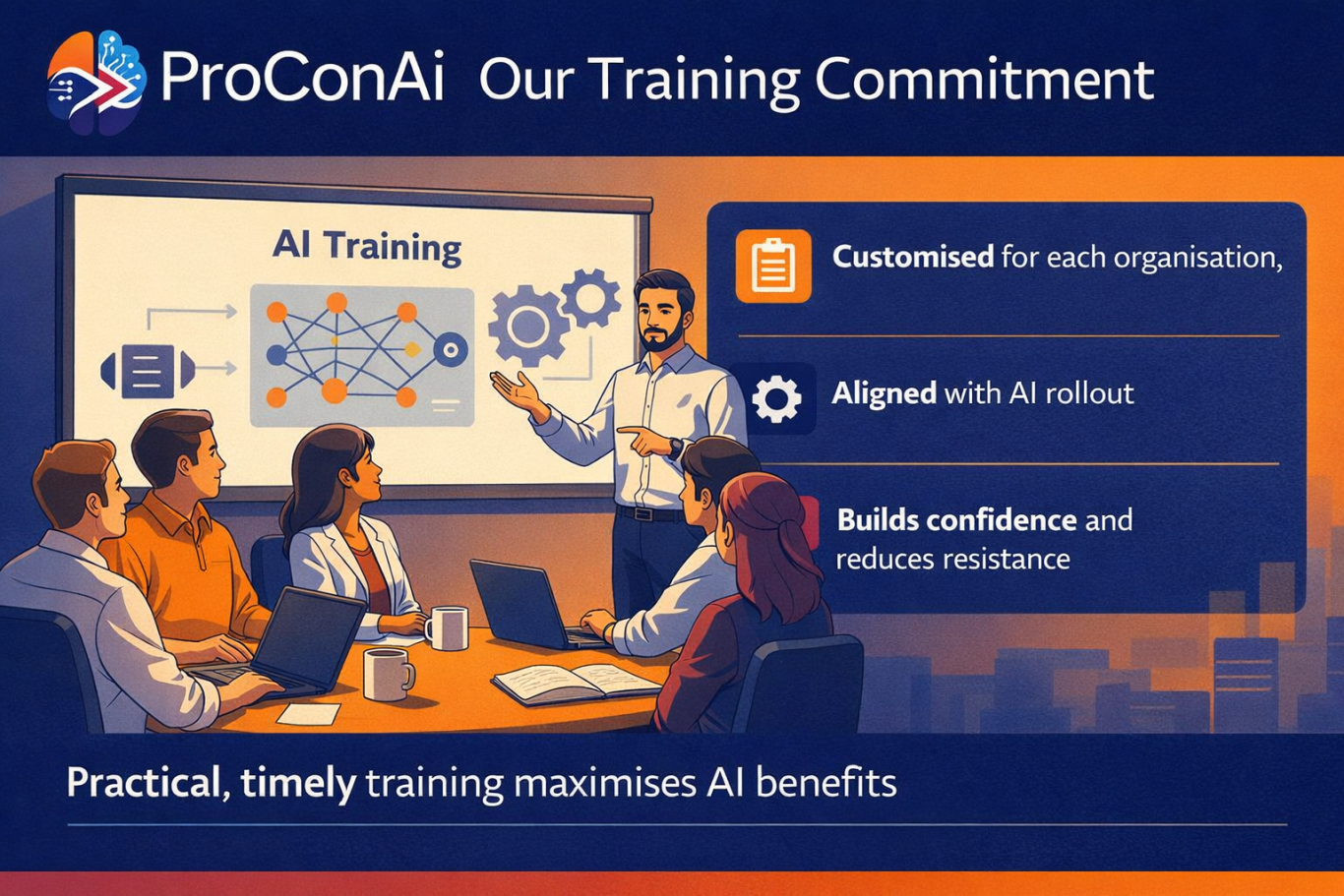
ProConAi customises training to fit each organisation’s structure, goals, and stage of AI adoption. By aligning training with the implementation of AI systems, teams quickly learn relevant skills and apply them in real scenarios. Integrating training from the start helps stakeholders understand capabilities and limitations, fostering confidence and reducing resistance. A well-timed, practical approach ensures effective adoption and maximises benefits, with sessions designed for immediate value regardless of operational model.