

Training from ProConAi
At ProConAi, we set new standards in Controls Consultancy by integrating Agentic AI into construction, infrastructure and capital delivery projects. Our expert-designed training programs equip all organisational levels with practical skills in Agentic AI, focusing on real-world application, ethics and sector-specific needs. We help teams harness innovation to lead with agility, turning data into actionable insights and measurable results. Partnering with ProConAi means joining a forward-thinking ecosystem dedicated to long-term business transformation. Discover how Agentic AI can elevate your projects and culture, choose ProConAi for expertise that drives the future of project excellence.
The AI Controls Team serves as a critical support mechanism for the Project Manager, significantly enhancing their capability to lead projects with clarity, confidence and precision. Through the automation of data collection, analysis and reporting, AI reduces the administrative workload on Project Managers and provides them with immediate, actionable insights into schedule health, cost performance, risk exposure and stakeholder alignment. The AI Controls Team is responsible for configuring and interpreting AI-driven forecasts, scenario models and early warning systems, empowering Project Managers to make prompt and well-informed decisions. Rather than supplanting the Project Manager, AI Controls augment their strategic influence enabling proactive leadership, dynamic adaptation to emerging challenges and delivery of outcomes with increased accuracy and resilience.
Controls Supporting Project Managers
- Site Monitoring and Progress Tracking: Tools employ AI-powered helmet-mounted cameras to collect site data and compare actual progress against BIM models. Project Managers access real-time dashboards detailing deviations, delays and productivity, expediting decision-making and resolution of issues.
- Predictive Scheduling: Solutions utilise machine learning on historical project schedules to forecast risks and delays, highlighting activities most likely to slip and suggesting mitigations for improved schedule reliability.
- Multi-Model Intelligence for Mega Projects: Systems used in large-scale infrastructure projects to identify hidden scheduling conflicts, predict material shortages and optimise crew scheduling, resulting in cost savings, earlier completions and heightened stakeholder confidence.
- AI-Driven Construction Scheduling: Platforms allow simulation of thousands of construction scenarios to optimise resource allocation, benefiting planning and execution by providing Project Managers with strategic options.
- Predictive Analytics for Infrastructure Projects: Project Managers enabled to anticipate delays and cost overruns, optimise resourcing and proactively manage risks, leading to improved delivery timelines and budget adherence.
- Real-Time Visibility Across Capital Projects: Platforms offer AI Control Towers, integrating data across multiple sources to provide early warnings, foresight and dynamic dashboards, shifting project controls from reactive to proactive.
As the adoption of AI accelerates within capital project environments, the integration of advanced site monitoring, predictive scheduling and multi-model intelligence is increasingly complemented by strategic frameworks that ensure alignment with organisational objectives. These innovations, when embedded within robust governance structures, support ethical deployment and transparency, while enabling project managers to leverage real-time analytics for dynamic planning, risk mitigation and proactive stakeholder engagement. With data architecture and digital twin technologies facilitating the seamless flow of information between PMIS, BIM, and ERP systems, continuous training and capability development become essential to realise the full benefits of AI. This holistic approach transforms project controls and performance management, underpinning the shift from reactive issue resolution to predictive, data-driven decision-making and ongoing improvement across the project lifecycle.
Strategic Integration
Strategic integration ensures that AI initiatives align with organisational goals and governance frameworks. This involves developing an AI strategy for capital projects that supports business outcomes, sustainability and digital transformation. Governance and ethical considerations are paramount, focusing on transparency, accountability and fairness in AI-supported decisions. Machine learning optimises portfolio prioritisation, ensuring effective allocation of resources, while predictive analytics track and forecast benefits realisation.
Integrating AI strategically also demands cross-functional collaboration to embed advanced analytics and automation into core project management processes. By fostering a culture of continuous improvement and supporting upskilling across teams, organisations ensure that AI-driven insights are translated into actionable strategies for programme and project management. This approach not only advances dynamic planning, predictive risk management, and real-time performance tracking but also strengthens stakeholder engagement and communication. As AI capabilities mature, ongoing evaluation and refinement of data practices, change management and emerging roles such as AI Controls Analysts and Data-Driven Project Managers are crucial for driving long-term value and maintaining alignment with both governance frameworks and evolving business objectives.
Programme Management
AI enhances programme and project management through dynamic planning and scheduling, predictive risk and issue management and automated cost estimating and forecasting. AI also strengthens change control and impact analysis by modelling the effects of changes and improves stakeholder engagement through sentiment analysis and optimised communication feedback.
Moreover, by embedding AI-driven insights into programme management workflows, organisations can facilitate data-informed prioritisation, streamline portfolio oversight and automate reporting processes, thereby enabling teams to respond rapidly to emerging risks and opportunities. This integration not only bolsters governance and transparency throughout the project lifecycle but also paves the way for adaptive decision-making and sustained value delivery, ensuring that programme objectives are consistently met in an evolving operational landscape.
Controls & Performance Management
Controls and performance management benefit from AI’s real-time monitoring and insight generation. Performance dashboards, anomaly detection, automated earned value calculations, productivity benchmarking and automated reporting all contribute to accurate and timely performance analysis and executive reporting.
By seamlessly integrating these AI-enabled controls into established performance management frameworks, organisations can further enhance the precision of forecasting, proactively identify emerging trends and facilitate rapid intervention when deviations from project baselines arise. This data-driven approach not only streamlines progress tracking and resource allocation but also empowers project leaders with actionable intelligence to underpin informed decision-making. As a result, the transition to robust data and technology practices, including digital twins and interoperable systems, is accelerated, establishing a solid foundation for the subsequent phases of project delivery.
Data & Technology
Robust data and technology practices underpin the deployment of AI in project management. Data architecture, digital twins, simulation models and seamless integration with PMIS, BIM and ERP systems ensure efficient data flow and readiness for AI. Continuous AI model training and validation maintain accuracy and relevance.
In addition, leveraging advanced integration capabilities allows organisations to extract greater value from vast, disparate data sources, enhancing the quality of insights used to inform project controls and decision-making. Secure and interoperable data environments facilitate real-time collaboration, while stringent data governance protocols safeguard integrity, confidentiality and compliance. As digital ecosystems expand, the adoption of scalable cloud platforms and the utilisation of emerging technologies such as IoT sensors and edge computing further extend the reach of AI-driven project management, enabling continuous improvement and supporting the evolving needs of complex, multi-stakeholder environments.
Capability & Change Management
Capability and change management are crucial for the adoption and maturity of AI in project environments. AI literacy is developed through targeted training, while organisational change initiatives support the cultural and process adaptations necessary for AI integration. The evolution of roles, such as AI Controls Analyst and Data-Driven Project Manager, and the assessment and road mapping of AI maturity underpin continuous development in this domain.
As organisations progress along their AI adoption journey, structured capability and change management frameworks help to embed new competencies and foster a culture of continuous improvement. By enabling cross-functional collaboration and knowledge sharing, these frameworks facilitate the seamless integration of AI into existing project processes. Furthermore, ongoing evaluation of skill gaps and the proactive refinement of change management strategies ensure that teams remain agile and responsive to technological advancements. This foundation not only accelerates the transition to data-driven project delivery but also positions the AI Controls Team and supporting roles to maximise value creation and enhance alignment with strategic objectives throughout all stages of the project lifecycle.
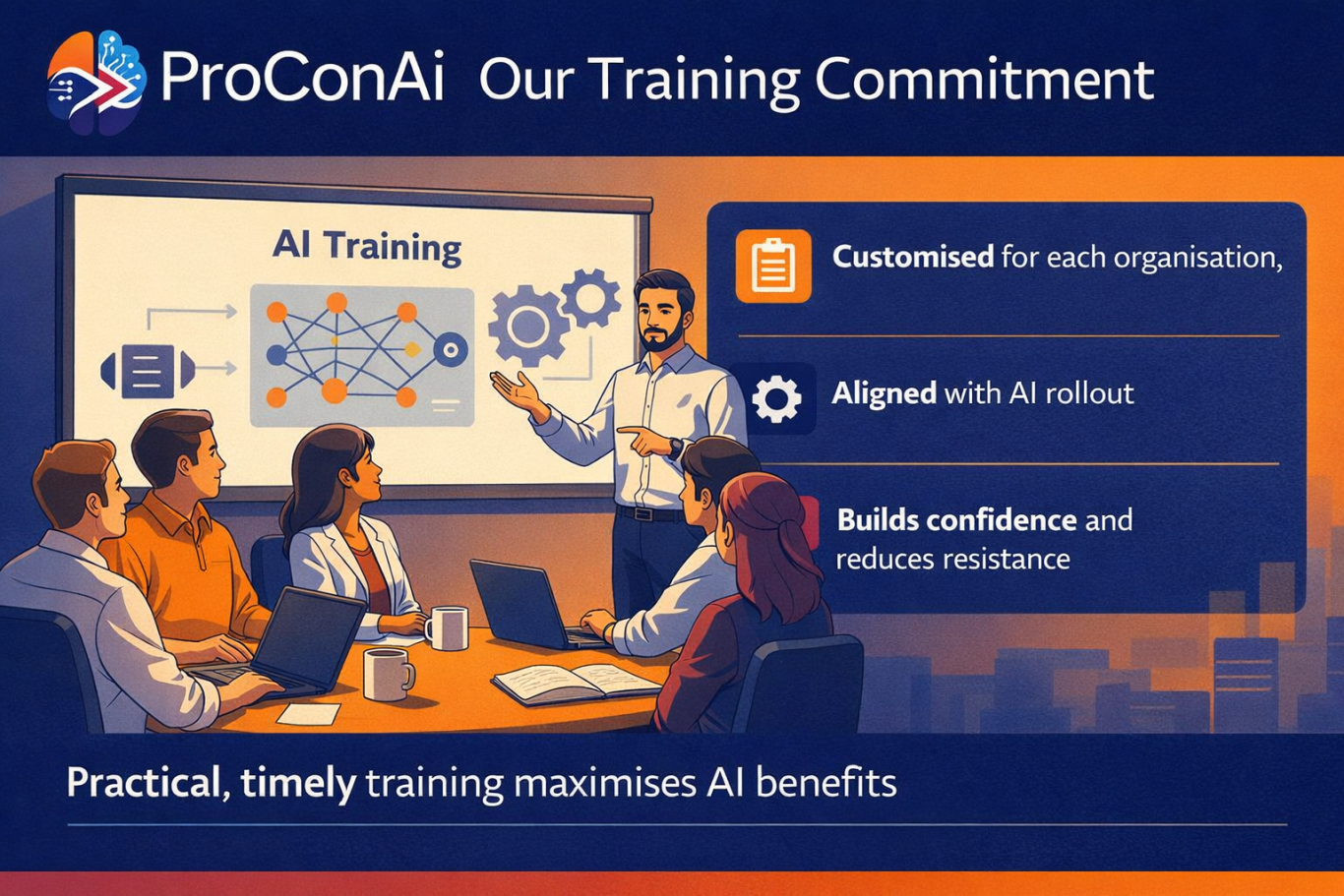
ProConAi customises training to fit each organisation’s structure, goals, and stage of AI adoption. By aligning training with the implementation of AI systems, teams quickly learn relevant skills and apply them in real scenarios. Integrating training from the start helps stakeholders understand capabilities and limitations, fostering confidence and reducing resistance. A well-timed, practical approach ensures effective adoption and maximises benefits, with sessions designed for immediate value regardless of operational model.